GGBFS Production Process
GGBFS Production Process
1. Process Overview
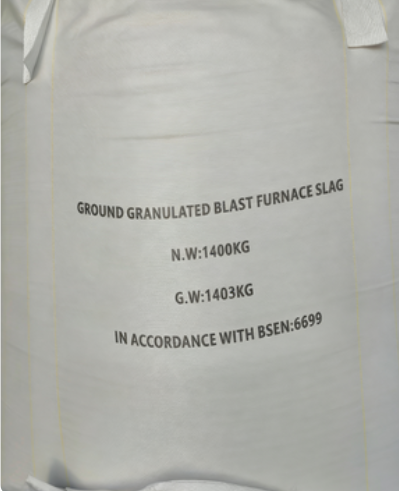
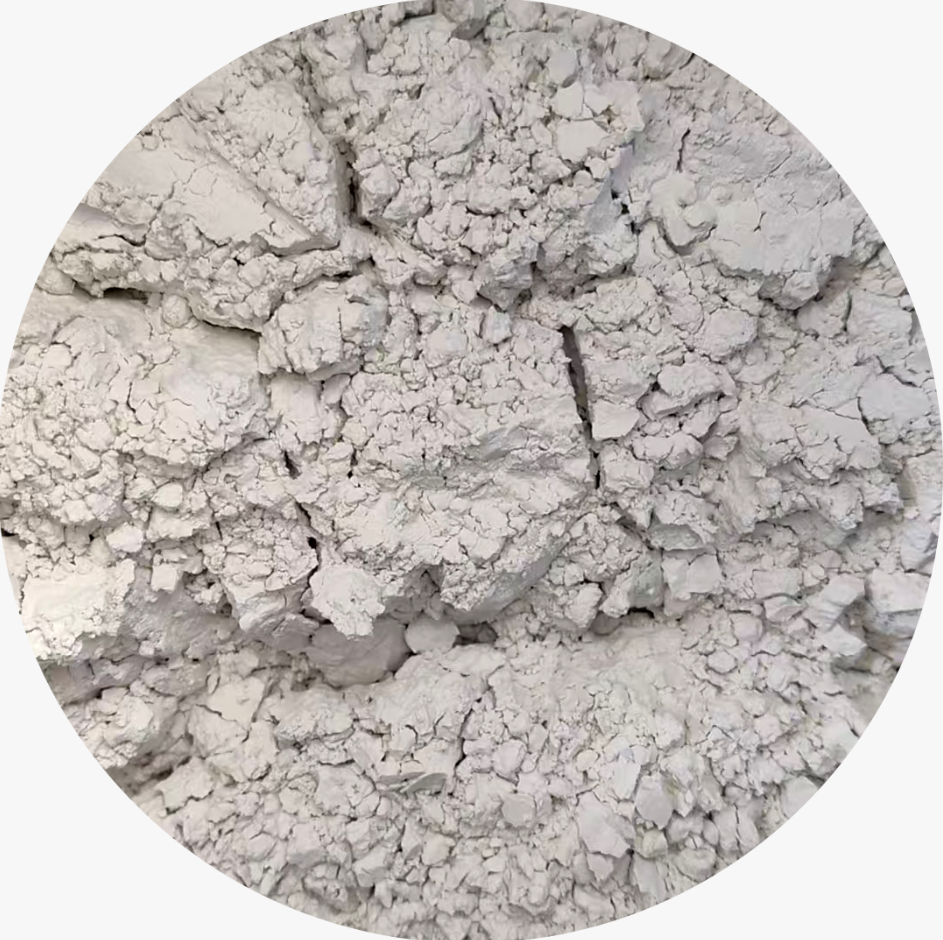
Granulated Ground Blast Furnace Slag (hereinafter referred to as ggbfs) is an ultrafine powder material (specific surface area ≥350 m²/kg, particle size mainly distributed in 5–45μm) formed by the treatment of "water quenching cooling →drying →grinding → classification" of blast furnace slag (molten state temperature 1400-1600℃) generated by the smelting of iron ore, coke, limestone and other raw materials during pig iron smelting in steel plants. Its core process logic is the stabilization treatment of molten slag combined with ultrafine grinding for quality enhancement. Rich in reactive silicon dioxide (SiO₂) SiO₂ and aluminum trioxide (Al₂O₃), the product has excellent pozzolanic activity and can be used as cement admixture or high-performance concrete admixture. It can not only utilize solid waste from the iron and steel industry (0.3-0.5 tons of blast furnace slag is produced per ton of pig iron), but also replace 30%-50% of cement consumption, reducing the cost of building materials and carbon emissions. It is a typical dual-attribute product integrating solid waste resource utilization and low-carbon building materials.
2. Core Principles
The production of Granulated Ground Blast Furnace Slag revolves around three core links: "rapid cooling stabilization of molten slag →activity excitation →ultrafine grinding". The key principles are as follows:
2.1 Water Quenching Cooling of Molten Slag: Formation of Reactive Vitreous Structure
If the molten slag discharged from the blast furnace (main components: CaO 35%–45%, SiO₂ 30%-40%, Al₂O₃ 8%-15%) is naturally cooled, it forms dense, inactive crystalline slag (such as dicalcium silicate and tricalcium silicate crystals). Through the high-pressure water quenching process (high-pressure water pressure 1.2-1.8MPa), the molten slag is rapidly cooled to below 200°C((cooling rate >100°C/s)), which can inhibit crystal growth and form granulated slag (commonly known as "water slag") mainly composed of "amorphous glass body" with glass body content ≥85%. This structure has high internal energy and can undergo secondary hydration reactions under the excitation of cement hydration products (such as calcium hydroxide) to produce strength, which is the core foundation for the activity of slag micropowder.
2.2 Ultrafine Grinding: Increasing Specific Surface Area and Activating Potential Activity
Granulated slag (initial specific surface area only 30-50 m²/kg) needs to break the vitreous structure via ultrafine grinding to increase the specific surface area to 350 500 m²/kg (high-end products can exceed 600 m²/kg): During the grinding process, the particle size decreases, the specific surface area increases, more active sites are exposed, and the reaction efficiency with cement hydration products is significantly enhanced; at the same time, the mechanical force during grinding can break partial chemical bonds to further activate the potential activity of slag. This enables the product to not only replace cement in concrete, but also improve the compressive strength, impermeability and durability of concrete (28-day compressive strength ratio ≥95%, in ratio ≥95%,in line with the national standard GB/T 18046-2017 "Ground Granulated Blast Furnace Slag for Use in Cement, Mortar and Concrete").
2.3 Classification Control: Ensuring Uniform Particle Size Distribution
The ground powder needs to remove a small amount of coarse particles (>80μm)(>80 μm) through classification equipment to prevent adverse effects on concrete workability and strength caused by non-uniform particle size. The classification accuracy directly determines product grade (e.g., S95 grade slag micropowder needs to meet "45μm square hole sieve residue ≤12%", S105 grade needs to meet ≤8%)
3. Complete Production Process Flow
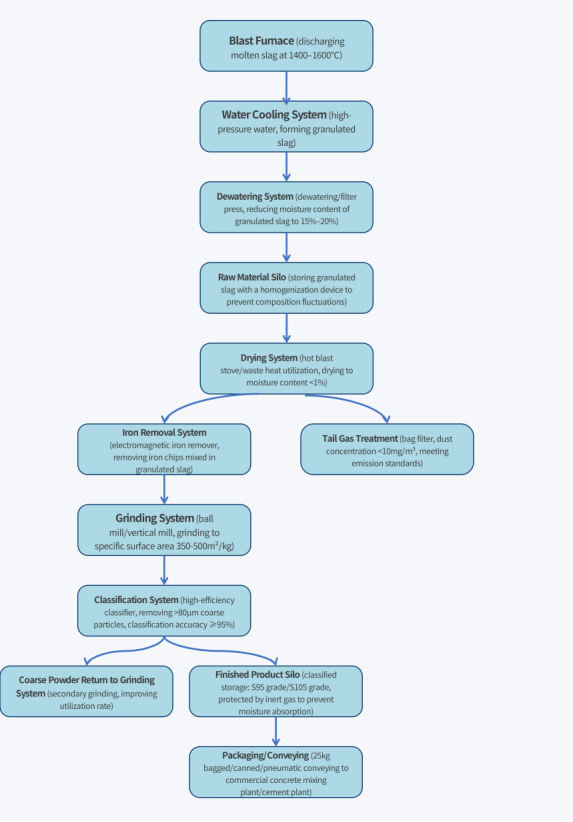
The production of ggbfs needs to implement the full process chain of "steel plant slag receiving →water quenching cooling →drying and impurity removal →ultrafine grinding →classification and storage" to ensure solid waste utilization rate >99% rate >99% and stable product quality. The specific process is as follows:
3.1 Process Flow Diagram
3.2 Detailed Core Functions of Each Stage
3.2.1 Molten Slag Receiving and Water Quenching Cooling Stage
• Blast Furnace Slag Receiving: When pig iron is tapped from the blast furnace in steel plant, molten slag is transported to the water quenching system via a dedicated chute (lined with refractory materials and temperature-resistant up to 1600°C). The chute needs to be fitted with an insulation layer to prevent premature cooling and agglomeration of slag during transport.
• Water Quenching Cooling System: The core equipment includes high-pressure water nozzles and a granulation tank. The high-pressure water pump pressurizes water to 1.2–1.8 MPa, forming a dense water jet through annular nozzles, which fully contacts molten slag and rapidly cools it to below 200°C, and while crushing it into granulated slag (commonly known as "water slag") with particle size of 5–20 mm. The water in the granulation tank is recyclable (after removing fine powder impurities via a sedimentation tank), and the water resource utilization rate >80%
• Dewatering System: The moisture content of granulated slag is approximately 30%–40%, which needs to be initially dewatered to 15%–20% via a vibrating dewatering screen (sieve aperture 0.5 mm). If moisture content still exceeds the standard (such as rainy season), a filter press is used for secondary dewatering. Excessively high moisture content increases energy consumption in subsequent drying and and easily causes clogging of grinding equipment.
3.2.2 Raw Material Pretreatment Stage (Drying + Iron Removal)
• Raw Material Silo: Storing dewatered granulated slag, the volume designed at 3000–5000 m³ for 1000 tons daily output). The bottom of the silo is equipped with a screw feeder to to maintain a stable feed rate; the silo is equipped with an air homogenizer to to prevent quality fluctuations caused by composition stratification of granulated slag.
• Drying System: Adopting a hot air drying process, the heat source prioritizes waste heat from steel plants (such as blast furnace gas or converter gas at 800–1000°C), and a natural gas hot blast stove is used when waste heat is unavailable; the drying equipment is a rotary dryer (inclination angle 3°–5°, rotation speed 3–5 r/min). The granulated slag contacts hot air countercurrently in the dryer and dried to moisture content <1% (moisture content >1% causes powder to adhere to the cylinder wall during grinding and reducing grinding efficiency).
• Iron Removal System: Iron chips (particle size 1–5 mm) from blast furnaces may be mixed in granulated slag and and must be removed via a two-stage electromagnetic iron removal system: the first stage: suspended electromagnetic iron remover (installed at the dryer outlet, removing iron chips with diameter >2 mm), and the second stage: in-line pipeline electromagnetic iron remover (installed at the mill feed pipe, removing iron chips with diameter >0.5 mm. Iron chips entering the grinding equipment wear the grinding media (such as steel balls) and and reduce product purity.
3.2.3 Core Grinding and Classification Stage
• Grinding System: The mainstream equipment is a vertical mill (preferred) or a ball mill + classifier combination. The characteristics and parameters of different equipment are as follows:
◦Vertical Mill: Integrating drying, grinding and classification in one unit, suitable for large-scale production (single unit processing capacity 50–300 tons/hour). During grinding, granulated slag feeds onto the grinding table from the inlet, the the grinding table rotates the material, which is which is crushed and ground by the rolling force of grinding rollers (pressure 8–12 MPa). At the same time, hot air rises from the bottom of the grinding table, drying the material and carrying fine powder into the built-in classifier. Advantages: low energy consumption (20%–30% lower than ball mills), small footprint; Disadvantage: high equipment investment.
◦Ball Mill + Classifier: The ball mill is loaded with steel balls (diameter 20–60 mm, proportionally graded). The cylinder rotation drives steel balls to impact and grind the material. The ground powder is conveyed to an external high-efficiency classifier by a fan. Suitable for small and medium-scale production (single unit processing capacity 10–50 tons/hour). Advantages: low equipment investment, easy maintenance; Disadvantage: high energy consumption, low grinding efficiency.
• Classification System: The core equipment is a high-efficiency vortex classifier, which controls classification accuracy by adjusting rotor speed (1000-2000r/min): higher speed yields finer classified powder (e.g., the 1800 r/min speed controls 45 μm sieve residue ≤8%, meeting S105 grade requirements). The classified coarse powder (>80μm) is recirculated to the grinding system via a return pipe for secondary grinding, and the fine powder (<80μm) enters the finished product silo with with raw material utilization rate >99%
3.2.4 Finished Product Handling and Environmental Protection Stage
• Finished Product Silo: Made of carbon steel or stainless steel, lined with epoxy resin (to prevent powder moisture absorption and caking), and stored in separate silos by product grade (S95, S105). The top of the silo is equipped with a pressure safety valve (to prevent safety risks from excessively high dust concentration in the silo). The bottom of the silo is equipped with a double screw conveyor and pneumatic conveying pump, which enables bagging (25 kg/bag, inner membrane woven bag, moisture-proof) or bulk canning (for bulk transport to ready-mixed concrete batching plants).
• Tail Gas Treatment: The dust-laden tail gas (dust concentration 1000–3000 mg/m³) from the drying and grinding systems is ducted to a baghouse filter (filter area is calculated based on tail gas volume, filter wind speed 0.8–1.2 m/min, filter bag material is polyester needle-punched felt). The purified tail gas has dust concentration <10 mg/m³, which complies with national standard GB 4915-2013 "Emission Standard of Air Pollutants for Cement Industry"; the collected dust (mainly fine slag powder) can be recirculated to the grinding system or or directly added to the finished product silo without generating secondary solid waste.
4. Key Equipment Parameters and Selection Criteria
Equipment Type | Core Parameters | Selection Points |
High-pressure Water Quenching System | Water pressure: 1.2-1.8MPa, water flow: 50-150m³/h (matching blast furnace capacity), granulation efficiency ≥ 98% | Match according to blast furnace slag output (e.g., an 80-100m³/h water flow system for a 1000m³ blast furnace); select wear-resistant ceramic nozzles to extend the service life. |
Vertical Mill | Processing capacity: 50-300t/h, grinding pressure: 8-12MPa, product specific surface area: 350-500m²/kg, motor power: 315-1250kW | Select vertical mill for an annual output above 300,000 tons (low energy consumption); equip with a hot blast stove to ensure simultaneous drying and grinding. |
High-efficiency Eddy Current Classifier | Processing air volume: 10000-80000m³/h, classification accuracy (45μm sieve residue) ≤ 8%, rotor speed: 1000-2000r/min | Air volume needs to match the grinder (e.g., a 20000-30000m³/h classifier for a 50t/h vertical mill); select a frequency conversion motor for easy adjustment of classification accuracy. |
Rotary Dryer | Processing capacity: 50-200t/h, cylinder rotation speed: 3-5r/min, inclination angle: 3°-5°, hot air temperature: 800-1000℃ | Adjust according to the moisture content of granulated slag (select equipment with 1.2 times the processing capacity for a 20% moisture content); line the cylinder with wear-resistant liner to prevent wear. |
Bag Filter | Filter area: 500-3000 m², filter wind speed: 0.8-1.2m/min, dust emission concentration < 10mg/m³ | Calculate the filter area according to the formula of tail gas volume ÷ filter wind speed (e.g., a 2500-3750 m² filter area for 30000m³/h tail gas); select waterproof filter bags for high humidity environments. |
5. Process Advantages and Application Scenarios
5.1 Process Advantages
1. High solid waste utilization rate: >99% slag utilization, no secondary solid waste can utilize >70% of steel plant solid waste (in addition to blast furnace slag, some processes can co-process steel slag and dust), reducing stockpiling and environmental pollution.
2. Significant economic value: Market value of slag micropowder is 20–40 times that of raw slag; as a cement admixture, it can replace 30%–50% of cement, reducing concrete cost by 50–80 RMB per ton, and and improving concrete durability (service life extended by 10–20 years).
3. Low-carbon and eco-friendly: Energy consumption for 1 ton of slag micropowder is ~60–80 kWh (mainly grinding power consumption), much lower than 120–150 kWh for 1 ton of cement, cutting CO₂ emissions), supporting the "dual carbon" goal.
5.2 Application Scenarios
1. Steel Plant Integrated Production: Large steel plants (annual pig iron production above 5 million tons) can build their own slag micropowder production lines (annual output 1.5–2 million tons), utilizing on-site blast furnace slag and waste heat to achieving integration of steel production and solid waste resource utilization, increasing annual revenue by 1.2–2.4 billion RMB, and while reducing solid waste disposal costs.
2. Cement and Concrete Industry:
◦Cement plants use slag micropowder as an admixture to produce slag Portland cement (slag content 30%–70%), which improving sulfate resistance and freeze-thaw resistance of cement, suitable for harsh environments like marine and underground engineering;
◦Ready-mixed concrete batching plants blend slag micropowder (content 15%-30%) into high-performance concrete for high-rises, bridges, subways and other projects, which reducing concrete hydration heat by 30%–40% and and preventing cracking.
3. New Building Materials Sector: Slag micropowder is used to produce new building materials such as autoclaved aerated concrete blocks and lightweight partition panels, improving product strength (compressive strength +20%–30%) and while lowering raw material costs (replacing 20%–30% cement).
6. Key Process Control Parameters
6.1 Water Quenching Cooling Control
◦High-pressure water pressure stably controlled at 1.2–1.8 MPa (if glass content <80%, product activity decreases; excessively high pressure wastes water, and and makes granulated slag too fine, easily clogging the dewatering screen);
◦Molten slag-to-water volume ratio controlled at 1:8–1:10 (insufficient water causes incomplete cooling; excessive water increases energy consumption).
6.2 Grinding and Classification Control
◦Vertical mill grinding pressure: Adjust based on target specific surface area (8–10 MPa for S95 grade, 10–12 MPa for S105 grade) - too low pressure reduces grinding efficiency and fails specific surface area; too high pressure accelerates roller wear and increases energy consumption;
◦Classifier speed: 1200–1500 r/min for S95 grade (45 μm sieve residue 10%–12%), 1500–1800 r/min for S105 grade (45 μm sieve residue 6%–8%). Sieve residue should be tested regularly and speed adjusted promptly.
6.3 Product Moisture and Specific Surface Area Control
◦Moisture content of dried granulated slag <1% (monitored in real time by online moisture meter, increase hot air temperature or reduce feed rate when overproof);
◦Finished product specific surface area tested every 2 hours by Blaine air permeability method, and the fluctuation controlled within ±20 m²/kg (e.g., 350 m²/kg products should be stably controlled at 330–370 m²/kg to to prevent unstable concrete performance from specific surface area variation.
6.4 Environmental Protection Index Control
◦Bag filter differential pressure controlled at 1200–1500 Pa (when differential pressure >1500 Pa, pulse cleaning performed promptly with cleaning pressure 0.5–0.7 MPa) to to ensure tail gas dust concentration <10 mg/m³
◦Drying system hot air temperature <1000°C (excessively high temperature causes local slag sintering and reduces activity), which is monitored in real time by temperature controller. When over temperature, reduce fuel or increase cold air mixing.
Through the above process design and precise control, slag micropowder production achieves full solid waste utilization, low energy consumption and high-quality products. It It not only solves solid waste disposal in the steel industry, but also supplies high-performance, low-cost raw materials for the building materials industry. It is a a model for industrial solid waste resource utilization and low-carbon development.